Wednesday, November 7, 2012

Goodbye Vanuatu

It's hard to believe it's here, but it's time to say goodbye. I've already ripped off the band-aide of leaving my village and in two days I'll be heading back to the good ol' US of A. So many thoughts and emotions come along with leaving a place you've made your home for two years: heartbreak, relief, excitement, dread, and many more. So as I reflect on my service, I mainly separate things into two groups - things I'll miss and things I will definitely not miss. You know I love making lists, so here they are:

Things I Will Miss
  • Evenings in my parents' kitchen
  • Fresh pineapples
  • Being able to take a nap anytime of day
  • The smell of laplap leaves hitting hot stones
  • Exchanging hellos with everyone I see
  • My sister and everything about her - my first, my most loyal, and my best friend in Vanuatu
  • The warmth and humidity
  • Regularly seeing sights out of National Geographic - dolphins, sea turtles, flying fish, parrots, etc.
  • Being a part of the Peace Corps family
  • Living in a country where everyone is a good dancer
  • The "Ambae Girls"
  • The rare experience of living in a foreign country where Americans are loved and respected
  • Banyan trees
  • The simplicity of life without electricity
  • The overwhelmingly lush greenness of the jungle
Things I Will NOT Miss
  • Roosters
  • Rainy season
  • My sister's cat (and kids for that matter) leaving turds outside my house everyday
  • Dirty feet
  • Cold bucket showers
  • Carrying heavy bags and cartons 2 hours uphill
  • Spiders falling on my face, rats using my clothes for nests, cockroaches getting into my food, lizards committing suicide in my wash bucket, slugs leaving trails on my dishes, and ants invading every meal
  • Having to leave my house in the middle of the night to use the toilet
  • Living under a microscope and being stared at all the time
  • Mold infestation
  • Rationing my toilet paper
  • Sexual proposals that begin with: "I've always wanted to sleep with a white girl. . ."
There's not much I can say to adequately end this adventure. It's been hard and exhilarating and life-changing. I'm so lucky to have been here and I will never forget the people who made my life here wonderful. Goodbye Vanuatu.

Monday, September 3, 2012

Not a Movie

As I get closer and closer to finishing my service here, these posts will become more and more sentimental. So you must forgive me. Or else switch to a newbie’s blogs – they tend to be funnier and less emotional.
One thing that’s been bugging me is my complete inadequacy at describing these past two years. When I look through my blog – at the selective, quippy descriptions of my life – I feel like what I’ve accomplished is describing a movie based on a Peace Corps volunteer’s experience instead of the reality. But the thing is, this isn’t a movie! Partly I know that because I’m not being played by a naturally beautiful Natalie Portman whose hair is flawlessly smooth despite the humidity, and who meets a perfectly rugged James Franco whose five o’clock shadow is fastidiously groomed. In actuality most male volunteers have unwashed locks and a scraggly neck beard, and there’s a reason everyone says I look “soooo different!” in my photos from home. Certainly I have had my moments where I felt like cameramen must be hiding in the jungle – perfect snapshots of what we could call the typical Peace Corps experience. Barefoot black children chase the Peace Corps truck down a dusty road yelling “Pis Kop, Pis Kop!” and waving madly. A human bridge of strong men braves a rushing river to guide a group of women and children to safety during a hurricane. I stand on the edge of a volcano with a good friend watching red bursts of lava shoot into the air as night falls on the jungle. I join in a cultural dance at a wedding whose ancient song tells the story in the tribal language of how the first boy met the first girl. A shirtless young man hacks a path through the jungle with a machete as he goes to fetch a bucket of spring water. But these snapshots don’t always do life here justice.
Mainly I know this isn’t a movie because solving a problem or implementing a program isn’t simply a matter of a 45 second montage set to an inspirational Coldplay song. You start out with awe at surviving in one of the most primitive places on earth and a personal satisfaction of donating two years of your life to the poor. But pretty soon your idealism slaps you in the face and you realize not everyone is going to greet your efforts with effusive thanks and smiles. You learn that effective development is not a smooth and easy path. You struggle with predictable loneliness, surprising boredom, and many many hits to your overinflated self-image (as the remarkable Paul Farmer puts it: “Serving the poor is more important than soothing your own ego. It’s called eating shit for the poor.”). You might hit the very bottom and think you have no purpose and nothing left to offer. But then an amazing thing happens and you find a bit of strength from somewhere. It might come from a huge accomplishment like successfully running a workshop, or it might come from a small event like laughing through lunch with your favorite “Ambae girls”, but it always comes before your last minute of desperation.
If this were a movie, at the end of two hours the president would bestow an award upon Natalie Portman for incredible service to the poor while staying super hot, she would marry an equally super hot James Franco, adopt a couple local children and turn them into Gap models, and come back to her village 20 years later to find a bustling utopia of fat babies and prospering families. I now know this will not happen for me, but I think my last scene will be even better. I’ve fought a battle for two years and I’ve come out the other side a stronger, more realistic and more tolerant person. And if even one person’s life is changed by me being here, at least I’ll know I didn’t have to pay them to say that to the cameras.

The Weird Thing About Being In the Bush For So Long. . .

. . .is that you start to forget you haven't always lived in the bush. One year and ten months of service has lulled me into thinking that this rustic existence is normal and my every-day life uninteresting. It was only my mom's recent visit that jolted me back into reality and made me remember that people might still want to hear stories. I'm sorry I've neglected my faithful readers (are any of you still out there?) - it's not that I've forgotten you and my life back home or that you're all any less important to me, it's just that that life seems farther and farther away.

While I've been absent on this blog, a lot has been happening in my tiny neck of the jungle. Mainly, the bridge project that has so long been a dream of mine is finally becoming a reality. My village and the neighboring village of Vuiberugu are quite close and act like one community. Their side has the medical facility, our side has the school, we often all go to church together, and people go back and forth every day. Since there are no vehicle-accessible roads anywhere near our two remote villages, we are linked by a small footpath that takes about 30 minutes to traverse (20 if Joel is with you, 40 if my dad is). Although generally no more than a moderately challenging hike, the presence of four creeks along the path can greatly impede travel plans. I should pause here to explain exactly what I mean by "creeks." Surely when I use that word a sweet, babbling stream of water comes to your mind - innocent, playful, and easily jumped over. Well then I need to provide you with a new mental image. These old lava flows are smooth, volcanic rock measuring about 18 meters across (yes, I've switched to the metric system. It's much more logical and literally EVERYONE else in the world uses it. Get on board America). Even in the not-quite-as-rainy season the wet stone is extremely slick and people slip and incur injuries all the time. Then when the rainy season comes along these dry creeks become raging rivers and prevent people from crossing to the other side for weeks at a time. Even in my short time here I've experienced times when I can't go to my parents' house or I'm stranded in Vuiberugu because of the overflowing creeks. Luckily it's only ever caused brief annoyance for me, but people often get separated from health care, food, and school, and I've even heard stories of flash floods sweeping people out to the ocean.

Naturally after my first rainy season in the village I was less than thrilled with these death traps and decided to try and see if something could be done. It wasn't as if people hadn't tried - locals had felled coconut trees, created bridges from bamboo, and even trained the roots of banyan trees to act as natural bridges, but one strong cyclone always washed these efforts away. They just didn't have the money or the materials to make strong, permanent structures. So I decided to try and take on the bridges as a secondary project. Through all the other projects I've mentioned, the bridge project has been moving slowly in the background. I won't go on and on about all the blood, sweat, and tears (literally) that have been poured into this project, but after a year and a half we finally found funding from the unlikely source of the German government - 2,214,140 vatu (about $20,000 USD). Since the money hit our bank account in June we have been busy getting the construction off the ground, and it's been a rocky road (pun intended). Everything that could possibly go wrong has, including but not limited to: an unfavorable exchange rate, a pedophilic architect (since removed from the project), a cement shortage in Vanuatu, a momentarily mutinous workforce (resolved), faulty equipment (as yet unresolved), finding stones where there should be none, finding no stones where there should be some, too much rain yet somehow a shortage of clean water, delays due to the necessity of asking deceased ancestors for permission to take down trees, and of course finding a way to get 20 tons of cement up a mountain with no road. There have been plenty times I thought there was no way it was ever going to happen, and maybe I still shouldn't count my faol before they're hatched, but we're making solid progress. Work is being done, and although it's unlikely I will see the entire project finished before I go home, people promise I will not leave Vanuatu without walking across one bridge.

Many times I have doubted myself and this project - it's the most difficult thing I've ever done and I really have no experience to qualify me to manage a project of this caliber. But when I think about the finished product and know that this network of solid, cement bridges will prevent mothers from having to give birth at home, children from missing a month of school, and elderly people from breaking bones, I realize the painful process doesn't matter. And besides, how can you complain about a job that included watching buff, shirtless boys swinging machetes??


Thursday, March 29, 2012

Mary Jane

The wonderful thing about babies is that they never feel the need to hide their thoughts and emotions. When I first arrived in my village 18 months ago, Mary Jane was a perfect example of this: she screamed every time I came near her. People would try to tell her that I was her Auntie - her dad's sister - but you just can't fool a 6-month-old and she knew my skin was the wrong color. She was not going to accept that she had a terrifying, pasty relative. I looked different, I sounded different, and by no means was I going to be allowed to come near her. Luckily for me and my mental health, toddlers are also extremely forgiving and willing to adjust their beliefs. You rarely find a one-year-old holding onto a grudge for too long. We've just passed Mary Jane's second birthday and I am happy to say she's now as loving and affectionate with me as with any of her true Aunties.

Mary Jane is built like a little tank - her big head, healthy belly, and sturdy legs give you the impression of a well-grounded square, and when you pick her up it's hard to believe she's only had two years to fill out that solid frame. One of my favorite things is to watch people try to put clothes on little MJ. It is always a tights squeeze to get her massive noggin into the chosen shirt for the day, and perhaps that's why she's much more likely to be found running through the village naked. Not much phases this little one and I've seen her come up dry-eyed from a spill that might have made me cry. Maybe it's her low center of gravity or her substantial figure, but she consistently seems to merely bounce off roots, rocks, and cement stairs. The rare times you do catch tears running down her pudgy cheeks she can easily be distracted and won't stay upset for long. The youngest of five children, Mary Jane lives in fear of being left out and will copy anything one of her beloved siblings does first. The first thing I ever heard her say was her sister's name and long before she could articulate complete thoughts she could point out and name all four siblings. Her easy-going nature makes her easy to have around and luckily for her all three brothers and her sister dote on her - especially 10-year-old Tari.

It's been an incredible pleasure for me to watch Mary Jane grow from a crawling baby to a running, talking, playful toddler. She loves domestic work and will often come keep me company when I was or try to help with the evening meal. MJ has found out that her Auntie Mac has quite a weakness for her and will often take advantage of that for hours of play. She likes hide-and-seek, peek-a-boo, and her own creation, "Butu Sala" (translated as "your shoe's gone!"). In this game the little munchkin will steal your shoe, put it behind her back, show you her empty hands and chant, "Butu sala! Butu sala!" Mary Jane knows only the tribal language and not a word of the national language of Bislama. I am in the process of learning the tribal language also, but currently I probably have about the same vocabulary as Mary Jane and perhaps that's why she feels so comfortable telling me stories about the chicken pecking a coconut, her grandma giving her a banana, or other crucial things that fill up her little world. MJ is not an easy person to win over. Unlike her attention-loving cousing William, Mary Jane needs some time to figure you out first. Even though she's past her screaming-at-every-white-person phase, she will still fix each new acquaintance with a quizzical stare that somehow makes you believe she'll end up knowing all your hidden thoughts. But believe me, it's worth the time it takes to work your way into her good graces. As cautious as she is, once you've been accepted into her circle you are awarded with dazzling smiles, chubby-armed hugs, and a fierce loyalty. If you can count yourself as loved by Mary Jane, you are truly in an elite and delightful group.

Peace Corps Invasion

Before last week the most white people that had ever been in my village at once was five - and that was only for an hour when the other "Ambae Girls" came up to get me last year for Thanksgiving. But on March 19, 2012 every Peace Corps business volunteer in Vanuatu along with our program manager and the PC administrative officer descended on Quatamwele for four days creating a buzz that will probably never be forgotten in North Ambae.

Twice a year volunteers meet with others in their program for training and updates (we call these MST's or Mid-Service Trainings). Usually these trainings happen in the capital of Port Vila since the Peace Corps office is located there and lodging for big groups is readily available. But for the business volunteers things went a little differently this year. First of all I should tell you that the business program has been cancelled in Vanuatu. While new health and education volunteers will continue to arrive each year, the 2010 newbies were the last business volunteers to come. Because of this and our strangely un-proportional early termination rate we are now a small, elite group of eight. Add to that the fact that there are no new volunteers to initiate and not much to talk about regarding our dwindling program, and you get a somewhat ambivalent attitude from the staff regarding us few brave souls. We still receive excellent support and care, but the attention has somewhat shifted to developing the two remaining programs. Because we are now a rogue program and able to fly under the radar, someone suggested we get out of Vila for once and experience rural life. Because I seem to live in the most "bush" site of the business volunteers, my quiet little village was chosen for this unique meeting. This of course deprived me of a free trip to civilization, but after promises of wine and chocolate were given, I readily agreed.

The week leading up to the meeting was frenzied. People in the area were awestruck and flattered that they were chosen to host such an important meeting and no small preparation was left undone. The grass was cut, the houses cleaned, the roofs were patched, meetings were held to determine the head cooks, and everything was planned to the letter. My friends and family kept pulling me aside and explaining how excited they were to meet all the "big men" and how we were making a history that will never be forgotten. You could see the eagerness in people's faces and could feel the anticipation in the air.

Finally the big day arrived and I went to meet everyone at the airport. Despite all my careful planning and preparation, the first major event did not go smoothly. The truck was five hours late. I tried calling his mobile, I went to his house, I enlisted all the store-keepers in the area to watch for him, and I did a lot of pacing up and down. Was this an omen of how this whole week was going to go?? But eventually he arrived and things picked up after that. We were dropped off at the last possible place the truck could get to and found half my village waiting to greet us and carry bags up the rugged path to Quatawele. That afternoon there was a huge welcome ceremony and everyone got settled into their rustic lodgings.

The next few days went by in a blur. The mornings were spent working on a community project - the building of our new church house. We carried cement up from the coast, shoveled sand out of the creeks, gathered stones to strengthen the mixture, and finally started laying the floor. The afternoons were dedicated to Peace Corps business and our small group met in the community house to share stories, ask questions, and gain valuable knowledge from each other. Every meal was fully catered by different mamas in the village and each one tried her best to outdo the last. Trays of food were paraded by, several different dishes crowded the table twice a day, delicious fruit of every kind was available any time, and each morning fresh flowers would appear to decorate the house. In the 18 months I have lived here I have never seen my village so full of laughter and fun. The other volunteers were amazing with my community - they storied with the adults and played with the children and were so generous with smiles and laughter that any apprehension people felt was quickly wiped away. People swam in the creek, learned a few words of the tribal language, and whole-heartedly jumped into life in North Ambae. In a very short time it didn't seem to matter who the volunteers were and who the locals were. People worked together and giggled together and created such a warm and loving environment as I've never seen before. Several volunteers let me know how special my community is and told me these few days were the highlight of their entire Peace Corps experience.

The four short days culminated in a thank you/farewell ceremony that went on for hours. Speeches were made, songs were sung, kastom dances were showcased, and there was even a skit put on by the area youth. Each volunteer and PC staff member received a fresh flower lei and had to shake hands with every member of the community. It was an emotional time for everyone and even some of the most powerful chiefs in the area had tears in their eyes as they sincerely thanked our group for honoring them with our presence. Then of course there was kava, tons of food, and even some warm beers, and people danced until late into the night on a grass dance floor illuminated by solar lights.

The next day everyone was out early in the morning to catch the truck to the airport and just like that my village was quiet again. Somehow it seemed so empty all of a sudden and I could tell from people's eyes how much they missed the ruckus. We've settled back into our daily routines now, but people still remember each volunteer's name and continue to tell stories about all the funny things that happened that week. I truly believe them when they say never in their lives will they forget that week.

Thursday, March 15, 2012

The Women of Waluriki

Each of the incredible women in my next biographical installment deserve their own blog post, but I look at the dwindling months of my time here and I know I won't get a chance to do everyone justice. So I've grouped them together, but don't make the mistake of thinking that makes them less important to my life here! These women who make my life so much happier and more fun live in the neighboring village of Waluriki, down at the coast. When I take the boat from Lolowai I land on their beach and take the road directly up the hill to my own little village.

First of the four is my Auntie Roline. Initially I got to know Auntie Roline through the handcraft group and quickly came to realize that she was the most talented and innovative of the basket-making artisans. Her baskets are consistently top quality and she's recently come up with a new basket design that is all the rage in Vanuatu. When I carry her creation around the capital of Port Vila tourists and locals alike inevitably stop me on the street and ask where they can purchase such a beautiful basket. Unfortunately, Auntie Roline is the only one who can create these unique baskets and there was no way for her to keep up with the demand. So we no longer market the baskets and only a lucky few get to decorate themselves with these collector's items. In spite of her incredible talent, Auntie Roline's weaving proficiency is not the reason she appears in this blog. Rather it is her quiet confidence, her loving personality, and her commitment to looking after me that makes her so special to me. Even when I was very new here and barely even knew the people in my own village, Auntie Roline took me under her wing and made sure I never wanted for anything. She has an amazing ability to pull fully cooked meals out of thin air and any time I see her she makes me eat. One time I protested and asked her why she feels she always needs to feed me. True to her personality she simply said, "Because I'm your Auntie and I like you." Simple, to the point, no-fuss kindness - that is Auntie Roline. Waluriki is in a central location and I often walk through it on my way to other villages or when I'm trying to find transportation to Lolowai. Anytime I pass her house I know I can stop and chat, get a drink of water or a snack, or even sleep on her floor if it gets dark and I don't want to climb the hill by flashlight. Somehow being with my Auntie Roline is so calming and comfortable - I know I can relax and just be myself and she will take care of me. She and her husband are also extremely supportive of all my projects - coming to my workshops, acting as liaisons to other villages, and helping organize the rural banking program. My life would certainly be a lot harder without the two of them.

In stark contrast to my quiet, unassuming auntie comes the other three Waluriki Wonders: Anita, Olga, and Betsy. These three are sisters and range in age from 18 to 25. In the very reserved culture of North Ambae, people usually try no to cause a scene and in public rarely show outward signs of emotion or affection. But these giggly, loud, and lively ladies break the mold. Being a hugger myself, it was hard to get used to living in a place where physical contact is rare and at best you might get a kiss on the cheek from your close female relatives. But luckily for me I found these affectionate sisters. Any one of these girls will launch themselves at me when they see me, hugging and laughing and pulling my hand to drag me into a gossip session. Sometimes their overly enthusiastic attitude and loud affection attract looks of disapproval from the more traditional women on the island, but I find them refreshingly fun and friendly. It is impossible to be lonely in their presence. Olga will come tackle me and refuse to leave me alone until I'm breathless and laughing like a pre-teen. Betsy will see me on the sidelines of a soccer game and promptly install me as team goalie (graciously ignoring my lack of skills). Anita will whisper in my ear and steal me away for a private gossip. On one occasion Betsy and Olga showed up at my house with mischievious twinkling eyes and poorly hidden giggles telling my family they had something extremely important to discuss with me. When we were out of hearing distance they confessed they were kidnapping me to accompany them to a birthday party in another village. I am quite sure my protective mom disapproved, but it made me happy for a week. In my community I am lucky to have a loving family and many people who respect me and look after me. But only Anita, Olga, and Betsy can be considered true "girlfriends." Although they could never replace my fantastic four at home, these girls have the ability to make me forget I'm a Peace Corps volunteer living way out of my element, and instead make me feel like a girl just hanging out with her friends.

Vilej bakagen

Although I greatly enjoyed my journey into the land of hot showers and cold beers, I have to say I'm actually very glad to be back in my tiny little village. When I finally arrived back in Quatamele after a 14-hour day of plane rides, truck rides, boat rides and lots of hiking, I was greeted by my family with my favorite kind of laplap and smiles all around. I laughed with my dad, played with the kids, and handed out presents from Australia, and although my first bucket shower in over a month was quite a shock to the system, I felt so relieved and happy to be back with the people of my village. The entire next day was devoted to claiming my house back from the squatting tenants who had occupied the empty space in my absence. I swatted spiders, shooed cockroaches, swept out rat droppings, and put EVERYTHING in the sun to try to fight back the encroaching mold. A few hours later my house was finally habitable again and I snuggled into my freshly laundered sheets.

The next few weeks were taken up by planning and running a small business workshop. I developed a three day training that would help people start a business, manage their business, and of course control the money within the business. Once again I tried to use a lot of games and activities to get people to really involve themselves and take the message to heart. One of my favorite activities was the first of the workshop. I gathered about 25 different items - all things that could be found on Ambae. There was a saucepan, a piece of fabric, a fishing line, an empty jar, a bag of sugar, a piece of bamboo, and other small things. Then I split the participants into groups of two or three and had each group choose one item. They then had to come up with a business idea using that item and decide on five other things they might need to start their business. I saw this activity open a lot of eyes and turn on a lot of lightbulbs. Sometimes people think that they have to move to the capital or work as migrant workers in New Zealand to make any money and I think they started to understand that money can be made on the island too. We live in a place with amazing natural resources and I loved seeing people start to figure out how they could use those resources. We had a lot of fun over the three days and of course ended with kava and a pig (as you have to with anything in Ambae). And then I slept for two straight days :)

Thursday, January 12, 2012

Watch Your Back

nakaemas (na-KI-mas) - n. sorcery, witchcraft, evil force directed by humans that can be used to kill and harm people.

The above comes from the Peace Corps issued Bislama/English dictionary. However, after perusing said dictionary more thoroughly (it's rainy season, ok? And I'm out of Sodoku) I decided I'm not quite satisfied with this limited description of a whole culture of superstition and magic - both good and bad. So let me illuminate the subject a little.

Although belief in magic pervades all of Vanuatu, the undisputed centers of mystical activity are Maewo and Ambrym. People hailing from these two islands are understood to have superior skills and are thus greatly respected and feared. Another PC volunteer told me that when her school's regional sports tournament was scheduled to be played in Maewo, several parents wouldn't allow their kids to go for fear of that infamous island. But if you're on their good side, natives of Maewo or Ambrym can be extremely useful. In our community house, where we hold meetings and keep all the supplies for the handcraft group, we were recently plagued by a very hungry rat. This troublesome rodent ate his way through plastic bags, yards of fabric, important papers, and he even managed to chew through a solar light cord. The chiefs of my village and the managers of the handcraft group decided that this was no rogue rat acting alone. Clearly someone was jealous of our success and either sent this rat or shifted into a rat to spoil our community. Luckily we were on good terms with a "Man Maewo" who is currently touring Ambae administering kastom medicine and teaching church choirs (not necessarily in that order). We appealed to him and for the low price of $3USD, Man Maewo performed some magic to rid us of our enemy. And lo and behold. . .we haven't found any bite marks since. Of course this rodent exorcism coincided with our deciding to keep all our valuables in big plastic trash cans so who know what the real deterrent turned out to be?

Even if you avoid the folly of gaining an enemy from Maewo or Ambrym, you still have to watch your back. "Devils" are everywhere. This is a term used quite often and through context I take it to mean either a ghost of a dead person or an ambiguous creature that comes out at night and will chase and eat you. Devils frequently factor in old kastom stories such as the origin of tattoos (I'll tell ya that one later), and in fact, the tribe I belong to is said to have come from a devil (one came from a stone, one from a tree, but we're straight from a devil - and they say that's why we're so good looking :) ). I once told my host family that Peace Corps doesn't want female volunteers walking alone at night and they fervently agreed. It was only later that my sister shyly asked me if it was because I was "fraet lo devil o fraet lo man?" Slightly taken aback I replied, "Oh, you know, mostly men, but I guess you can never be too safe!" The next day my brother-in-law showed me a special plant in the jungle that devils are terrified of - holding it will repel them and strewing it in your path will ensure you're not pursued. I guess now I just have to worry about the man part!

Although I'm making light of this subject, magic is taken extremely seriously throughout the entire country. I've followed newspaper stories about black magic trials in Federal Court, I've witnessed a sori ceremony complete with an exchange of pigs and mats worth hundreds of US dollars following a threat of nakaemas against our chief, and I've heard numerous stories about vigilantes taking justice into their own hands on a suspicion of black magic. But luckily, during a discussion on love potions, I was informed that Vanuatu magic doesn't work on "white women". I was relieved, even if that comment left some of the guys looking slightly crestfallen :)

Marooned!

I was this close to making a volleyball my best friend, but I've escaped my tropical island just in time. The one place for internet on Ambae was out of service, the one truck that goes to my side of the island was broken, the ocean was too rough for boat passage, and in general the wind and rain made it impossible to leave my tiny village. Add that all up and you get some major island fever. But I am now embarking on a much needed and intensely anticipated vacation. I will be in the capital city of Port Vila until Jan. 18, then I will be flying toward two wonderfully unplanned and work-free weeks in Sydney, Australia. I'll be back to Vila on Feb. 1 and then doing work for the Gender and Development Committee, finally going back to Ambae on Feb. 17. A whole month away!

Since I have been off the radar for the past few months, here are a few updates:


  • I got a kitten! Her name is Pikay, named for a popular brand of gum in Vanuatu, PK. In my village, when something is insubstantial or "smol tumas" people will say it's "chewing gum nomo!" Given that Pikay is currently about the size of a softball I though the name was fitting. But what she lacks in size she makes up for in ferocity. She is unaware that she is about as intimidating as a stuffed panda bear, and often gets into standoffs with large dogs whom she feels are invading her turf. Although she hasn't caught any rats yet (the purpose for which she was brought to me) she has left several disemboweled lizards at my doorstep so I see great potential in my little jungle cat.

  • Ranking just below my cat (haha, just kidding Joel!). . .We got a new Peace Corps volunteer in my area. Joel arrived in my neighboring village of Vuiberugu on December 12, and it's awesome to have someone klosap again. I won't embarass him too much, but I'll just say he's a health volunteer from Texas, he's a great fit and people already love him.

  • My niece got into secondary school in East Ambae. She's such a great girl and I'll miss her a lot, but I'm glad she gets the opportunity to continue schooling.

  • Christmas and New Years were nice, but with too much laplap and too many drunk people. Let's just say I'll be glad to be back for the holidays next year!

Ok, now you're pretty up to date. I hope to be writing on this blog thing some more in the next month since I'll have available internet. Thanks for tuning in!

Tuesday, September 13, 2011

Aru

Aru was my first (and still one of my only) young male friends. The cultural separation of men and women and my own belief that a self-imposed distance from the mischievous youngfala boys increases my acceptance by the woman keep me from becoming too close to any men my age. However, most of our handcraft group's best carvers come from this demographic so out of necessity I struck up a relationship with the informal leader of the group: 25-year-old Aru. The boys sensed my hesitation to get too involved with them so they would send Aru to my door to ask for carving tools or negotiate prices and I in turn would send him back with tips for cleaner carvings or requests for specific products. Our friendship has grown (cautiously) through the months and after his village of Vuiberugu selected him to go to the leadership camp in May we've gotten to know each other better.

Besides being a contender for sexiest man alive (he has a smile that will make a girl forget her own name. But don't worry - he's happily married to a sister of mine and is a doting father to three adorable girls), Aru is an incredible leader, an extremely hard worker, and loves life with an enthusiasm that is contagious. Only finishing school through the 6th grade he considers himself dumb and uneducated but in reality picks things up with amazing speed and ease. Show him something once and he can do it. Show him something twice and he can teach someone else how to do it. He amazed everyone at the leadership camp with his proclivity for American sports - showing an effortless mastery of American football, Ultimate Frisbee, and even Yoga while his friends struggled just to understand the rules. You might expect someone as gifted as Aru to be arrogant and selfish with his skills but you would be surprised. He just doesn't understand the point of keeping knowledge to himself. Anyone who asks is welcome to his array of knowledge from how to play the guitar to how to carve the perfect dolphin to how to make home brew. If you told this unassuming and humble guy he was a natural leader he would deny it with embarrassment, but I think he acknowledges the adoration of the younger boys and tries to take every opportunity to show them how to be better men and specifically how to be better husbands. In a culture where domestic abuse is at least tolerated if not encouraged, Aru tells the boys it's not ok to hit their women. One time he told me the main thing he tells them over and over is that they all "mas gat love lo ol man."

Aru knows he will probably spend the rest of his life in the village. He's not trying to run for office or add things to his resume. He just truly wants everyone to live as full a life as they can, and if he can help - he will.

I don't have a lot of male friends, but I'm satisfied with choosing quality over quantity :)

Turn Right at the Coconut Tree

After living in this wonderful and exasperating country for a year I have grown to understand and even enjoy many of its quirks and idiosyncrasies. However there is one source of unending frustration that I have not been able to accept: the manner in which the people of Vanuatu give directions. On a side note I now find I must apologize to my oldest brother and his lovely Irish lass for previously accusing the Irish of being the worst possible direction givers. Sure they might send you through a string of unnecessary roundabouts, confuse you by giving contradictory information, or even lie to avoid admitting ignorance, but at least when you find yourself hopelessly lost some helpful soul will happily show you to the nearest pub and allow you to buy him a pint for his assistance. No such luck in Vanuatu.

Let me give an example of how directions are typically given here. A woman in your handcraft group has invited you to her house to talk about a new style of basket (and inevitably eat a heaping plate of simboro). You ask someone you know how to get to her house. "Oh yes!" they enthusiastically reply. "I know her! She's so-and-so's dad's cousin's sister! You know so-and-so in the next village over? Well her brother married your uncle's daughter and their son married so-and-so's mother's auntie's daughter!" Yes, yes, that's all fascinating and memorable of course but where is her house? "Ok, do you see that Naos tree up there? Her house is 'nother saed long wei'." Now here your months in the bush have taught you to pause. Even if you can determine which tree out of a dense mess of jungle vegetation that stretches on for miles is being referred to, the phrase "long wei" needs some illumination. In the muddled language that is Bislama "long wei" can either mean "over there" or quite literally "a hell of a long way away." You must clarify to determine whether your trip will require a packed lunch, a sleeping bag, or perhaps a week's supply of clean drinking water. Once the relative location and distance of the house is determined, you ask for detailed directions. "Take the path on top until you come to two coconut trees. Follow the path by the smol smol one. You'll go up a big hill then down a little one, up a little one again, and then down a sorta big one. Then you'll come across your uncle's cow - take the path to the right of the cow. Follow the path for a little bit more and you're there! It's the house with the natangurra roof."

Although perhaps you're not quite clear on the details, you're confident this is as good as you'll get so you set off. Almost immediately you are confused. Where there are supposed to be two coconut trees there are three! All of various sizes! You're supposed to follow the smol smol one, but was that determined before the even smaller one started to grow? You pick one and take a chance. Things start to improve. You traverse the hills easily and after going down what's probably the "sorta big" hill you see the cow! You permit yourself a break and a celebratory drink of water. But then. . .right in front of your horrified eyes the cow moves! Now both paths are to the right of the cow! What to do? You consider giving up and in desperation ask the cow if she can at least direct you to the nearest pub, but the only response you get is a lazily hostile chewing of grass. You sigh thinking how good a Guiness sounds about now but there's nothing to do but pick a path and follow it. Soon you arrive in a clearing and see a house with a natangurra roof. That must be your cousin's auntie's grandma twice removed or whatever's house! But then you look around and see five more houses with natangurra roofs! Luckily at this moment a curious kid comes to stare at you and can be persuaded to show you the right house. You are welcomed with smiles and food and can finally relax. Until the trek back. . .

Thursday, June 23, 2011

Fr. Mark

Fr. Mark Mwera is a happy, playful, and somewhat flirtatious guy, tiny in stature and huge in smiles. But if you want to say that to his face you're gonna have to shout. Quatamele's retired priest, at age 81, no longer hears very well, sees very well, or can go too far without his walking stick, but his heart is still that of a child's. He loves to read picture books, sing children's choruses, and tease the little kids. But although everyone in the village calls him Grandpa Mark and nothing lights up his face like playing with one of his many "grandkids", he has no children of his own. Anglican priests are allowed to marry but Fr. Mark never got around to it. When you tease him and ask him why he never found a good woman he gives you a different response every time. "You women are trouble and I wanted a peaceful life" he might say, or "I found one once but she loved someone else," or my personal favorite "Well I never found a woman that's as good looking as me!" But although he has no wife to cook for him, daughters to sew for him, or sons to cut firewood for him, our area is filled with his family members who try their best to look out for him. However, helping Fr. Mark is not an easy task and often his well-intentioned relatives become exasperated with the stubborn old man. And here's why: any little gift intended to make Fr. Mark's life easier will fly out his door before he ever uses it. New shoes will be found on his nephew's feet, a rain coat will turn up keeping a child dry, and food finds it's way into the kitchens of all his friends. "Stop giving stuff away - that's meant for you!" his frustrated relatives will exclaim, but that's Fr. Mark's style and he's not likely to change it soon.

Although at first glance Fr. Mark is just a goofy little grandfatherly figure, truly he is as wise as his years and has had some amazing experiences. He remembers well when the U.S. troops came during WWII (he can sings the whole Marine theme songs and sometimes when I walk by he salutes me) as well as when Vanuatu gained it's independence, and he worked for over 10 years for The Republic of Vanuatu's first (and some would say only successful) government. He has written a fascinating story about his life so people won't forget him, and I'm going to copy it and put it in a nice book for him as a surprise.

Yes you strain your vocal chords when you story with Fr. Mark, but hearing his corny jokes, his interesting experiences, his beautiful and heartfelt sermons, and his expert kastom story telling is well worth it. Fr. Mark easily takes down your defenses and makes you laugh, but look out - he might not be as harmless as you think. He keeps threatening to steal my passport so I'll be stuck forever in Quatamele, unable to leave him :)

What I Really Do Up Here

When I started this online documentation of my adventures in Vanuatu I promised myself I would never become the typical self-agrandizing blogger who uses words like "self-agrandizing" and urges her reader to realize how awesome she is. But it looks like I didn't make it very long. I must apologize, but I'm so excited about all the great things going on in North Ambae so you're just going to have to let me gush and brag for a post. But if it makes you feel better you can all write me about the cool things you're all doing :)

So here's the update:


  • My treasurer training workshop - One of the problems I've begun to see in my area is the widespread gross mismanagement of money. Community and group funds are constantly being raided for personal use - often by the treasurer of the fund or his family. Now maybe I'm too naive and haven't gotten the chance to have my idealism and my optimism kicked out of me yet, but I don't believe this embezzeling is going on because the treasurers are bad people. In fact I know many of these individuals and they're wonderful people. No, I think this problem comes from the fact that many people are just confused about money in general. Money is a fairly new concept in these parts, and in a culture that still often uses kastom woven mats and pigs as currency, it's hard to fully understand the value of a little piece of paper. I do not want to insult the intelligence of the people I live with - of course they understand that money has value and they can take it to a store and exchange it for salt and soap. But at the same time they haven't had the generations to get used to the idea of paper currency that we have, and how to use it right and manage it well can be somewhat of a mystery. In addition, in this culture if a family member asks you for something you are honor bound to give it to them. Food, clothing, tools, and even money are often thought of as family property and to refuse someone is to cause great shame. Now it is not my place (or even my desire) to question or change these cultural practices. I admire how tightly knit and supportive these families and communities are here. However when this "help yourself" attitude starts to seep into community funds, church funds, youth group funds, etc., resentment grows and fights break out. So last week I did just a one day workshop on how to be an effective treasurer. We talked about the correct way to release and receive money, how to keep good records, how to report back to your group, and most importantly the accountability you have to keep the money safe. I think it was pretty successful but we'll see if it does any good.

  • My family budget workshop - Word spread about the one I ran in my village in March and next week I'm doing it again in the neighboring village of Vuiberugu and I'll be doing another one in Wainasasa in September. Hmm. . .that actually isn't that interesting or cool. Next.

  • My rural banking project - It's gonna happen, it's really gonna happen! I would never publicly admit this but I'm actually very surprised this is going ahead. A note about North Ambae - people don't think we're very important. We don't have much development or wealth and we're largely illiterate (of course I could go on and on about how awesome we are but I'll save that for another time). We're basically the hicks of Ambae and people tend to ignore us or mock us (a common saying is "North hemi zero." Really nice East Ambae - you guys are clever!) But regardless there is some money around here and I think it would really help people's money management skills to have access to a bank (for now money is buried or put in an old peanut butter jar), however to hire a boat to the nearest bank in Lolowai is the equivalent of $60 USD - an astronomical sum to most people here - including me. So I thought - if people can't go to the bank, bring the bank to the people! I can't really credit myself with this idea (sadly) because the National Bank of Vanuatu (NBV) already has a mobile banking program. Just not in North Ambae of course (remember? We're "zero.") So I decided to pull it to us. I started in February by requesting a meeting with the Head of Rural Banking in Vila and he grudgingly accepted (I don't think he wanted to but in this country people work pretty hard to keep the Peace Corps on their good side). By the end of the meeting I had gotten his mandate - but that's it. I could use his name if I wanted but he wasn't going to make any calls for me. Next step - local branch in Lolowai, East Ambae. Through a combination of smiles and refusing to go away I got them to agree to a financial literacy toktok in North Ambae and then (more smiles and refusing to go away) they agreed to start sending a guy once a month to do deposits, withdrawls, and maybe even some microfinance loans. Next step - get the bigwigs on board. With the help of my wonderful chief I called a meeting of some chiefs, church leaders, the one rich guy in North Ambae, and the school headmaster - basically 8 of the most powerful men in the area. Trying to keep the butterflies in my stomach from choking me or making me throw up I pitched my idea (I couldn't even rely on my sister who usually helps me through these things with supportive smiles and head knods because she opted to sit outside and listen at the door. Coward. And this woman is not easily intimidated). And. . . they loved it! They all agreed it would be great for the North and said they backed me 100%. They'd even help with providing a venue and helping me spread the word (not easy in a world without cell phones, email, or trucks - we basically pass notes). Our first NBV day and official kickoff of the program is next month so there's plenty of time for things to go wrong but I hope I hope I so much hope this will go smoothly.

  • My (I use that term loosely) youth group - The two guys I brought to the Training of Trainers last month (remember? the youth leadership camp that you guys helped pay for?) have taken it upon themselves to start a youth group in Vuiberugu. Every Sunday after church the youth of the area gather to sing, tell kastom stories, and play all those silly camp games we taught at the TOT. Then these two (Aru and Tensley) sit them down and talk to them about one of the subjects we trained them on. They've covered leadership, communication, and building trust, and next week is good teamwork. With minimal help from me (we meet every Saturday to go over what they're gonna say and I jump in if they get stuck) and with zero resources and limited formal education, these two have started successfully building up the youth in the area. Sounds to me like money well spend :)

  • My dove necklace project - As a proud member and treasurer-in-training of the Gender and Development Committee I'm always trying to find ways to help our dismal bank account (it's a long story but we're very limited in where we can seek funds). As one of the managers of our local handcraft group I'm always trying to find new markets for the products. And Nancy and I have found a way to do both! I worked with North Ambae's incredible carvers who can make beautiful jewelry out of nuts, seeds, and shells, and we designed the Peace Corps Dove Necklace - a re-creation of the Peace Corps symbol made from a natangura seed. They've become very popular with the volunteers in Vanuatu and the orders are flowing in. Half the proceeds go to the carver and half to the GAD committee.

So there it is! I'm super busy and slightly exhausted, but very happy. As those closest to me already know, I'm never more content than when I have lots of work to do, plenty of projects to complete, and maybe just a few too many committments on my calendar.

Tuesday, May 17, 2011

6 Months is the Coconut Anniversary, Right?

In honor of my six month anniversary of living in Quatamele, I would like to give you a summary of my time here. As an accountant I can only do it the way I know best, so here is six months in the jungle - by the numbers.

Days I've been at site - 180
Days since my feet have been clean - 180
Number of times a lizard has fallen out of a tree onto my head - 3
Days since my last hot shower - 74
Months since I've shaved my legs - 2+
Number of times I've fallen in the creek - 1
Months since I've worn any footwear other than flip flops - 8
Pairs of flip flops I've worn out - 4
Number of my necklaces stolen by a rat - 1
Straight days I've eaten simboro for at least one meal - 26
Days since my last manicure - 241
Number of pig killings I've witnessed - 6
Ants crawling accross my computer right now - 3
Number of people I've seen pick their nose today - 5
Days since I've spoken English - 7
Number of times I've almost been killed by a coconut - 1
Number of times I've almost been killed by a tiny boat almost sinking - I don't want to say because my mom reads this blog
Number of Prime Ministers who have governed Vanuatu since I've been here - 3
Bottles of insect spray I've gone through - 8
Days since I've seen a car/truck - 21
Number of times I've wanted to give up and go home - many
Number of times I've been glad I've stuck it out - more than above

Thursday, April 28, 2011

Evelyn

Unlike my outgoing, talkative dadi, my momi is quite shy and known throughout the community as being a quiet woman. While my dadi tells elaborate, exaggerated stories, she is content to sit in the background, her hands always working - peeling taro, weaving a basket, or rocking one of her many grandchildren to sleep. When he gets to a particularly ridiculous part of the story, she might raise her eyebrows at me or scrunch up her nose and shake her head, but her great affection for him and her quiet nature keep her from outright contradicting him.

This incredible woman whose saucepan is always full and whose kitchen is always open to hungry grandchildren daily endures the indignities of small hands pulling her hair, small feet dirtying her clothes, and small runny noses being wiped on her skirts, but she never loses her good humor. It is easy to make her laugh and when she finds something truly funny she squints up her eyes, throws back her head, and lets out a huge laugh unexpected from such a quiet woman.

Momi Evelyn has no interest in village politics or community development, but she loyally shows up to every meeting, every community work day, and every workshop. I know she would prefer to stay in her peaceful kitchen undisturbed, and her presence at these policy-making events is purely to show her support for me, my dadi, my sister, and whoever else might need to see a friendly face.

Despite her gentle demeanor, my momi looks out for me like a mama bear and woe to the man that gets in the way of my eating or sleeping. The first day of my workshop, as we neared our lunch break momi discreetly approached to tell me she had food waiting for me at the house - she knew I had been too busy to think about it that morning. At the break some participants came up to ask individual questions and I saw my chance to eat quickly slipping away. At this point my unobtrusive momi came up to our group and said some very sharp words in the local language. Although I didn't catch the exact meaning, the hasty retreat of the questioners told me momi had voiced her displeasure that they were keeping me away from my simboro. I am never allowed to go hungry and always the best of her garden - the ripest mandarins, the biggest tomatoes, the sweetest mangoes - find their way to my already overflowing plate.

I get great comfort from my momi. Her quiet, consistent presence makes me feel peaceful, and she seems to be the only one in the village who doesn't have the need to constantly pepper me with questions or requests. Often we can peel taro, rasras bananas, or roll simboro without talking - content to just sit together. She never fusses over me and without comment lets me crouch down around the fire with her, subtly teaching me how to cook, wash, and paint mats - imparting her vast knowledge of what it means to be a woman in this culture.

Surely I would be lost without this soft, loving woman, and her calming presence makes living this crazy experience possible.

I'm Back!

I've been away from my blog lately because I haven't been around the Internet and I've been busy busy busy. And before that. . .I had nothing interesting to report. January was a tough month filled with cyclones, and I experienced the worst Peace Corps hardship yet - Excruciating Boredom. I had no cute, witty stories to fill my blog (once you get over waking up with the first lizard in your bed, the second and third bed-invading lizards just don't provide good material. If you've heard one lizard story, you've heard them all) and I had already complained enough about the weather. Then most of February was spent in a classroom in Vila and I was pretty sure you guys didn't want to hear about Project Design Management or how to maintain good mental health out in the jungle.

But don't you worry because now I'm back in the village and gathering lots of blog-worthy material. The sun has come out, I have lots of work to do, and the weeks are flying by.

One of the highlights is that I ran my first workshop. Weeks of planning and preparing culminated in a 2 day workshop on Family Budgeting and Household Money Management. In a total of 10 hours I worked with people with little or no education on how to properly manage their finances. We played games, did group activities, and they listened to me talk way to much, and at the end we celebrated with kava and a roasted pig. Among the attendees were 15 men, 13 women, some kids and a chicken, and I was very pleased with the turnout (except for the chicken - he was very rude and disruptive and had to be kicked out of class). It seemed pretty successful. Already word has spread and several other communities have approached me to ask if I could bring the workshop to their area.

As for my other work: I found an additional buyer for our handcraft group so we're getting busier, I'm helping with the budget and the finances of building a new church house, I've been working individually with some small business owners, and I hope to soon be successful in getting the National Bank of Vanuatu to come start a rural banking program in m area. Like I said - busy! But being busy makes me happy and I finally feel like I'm doing the work I came her to do. The last thing I want to do is turn North Ambae into a greedy, capitalist society, but if I can instil some financial competency, help provide ways of making income (if wanted), and train people how to plan for the future, I will consider myself lucky to have had such success and will be extremely grateful I can give back even a tiny portion of what these amazing people have already given me.

Thursday, February 10, 2011

How Kymani Marley Saved My Relationship

This past week in Vila has not been a good one. Of course I'm enjoying showers, lights, and seeing all my PC friends, but in general my initial optimism and humor where Vanuatu is concerned was growing thin. And I believe the problem comes from the fact that Vanuatu and I have reached the point in our relationship where we are past the honeymoon phase but not quiet truly comfortable with each other yet. All those little things that were so charming and original when we first met have become simply another annoyance that often leads to a fight. Where before I loved the relaxed, easy-going way of life, now I am frustrated that it takes infuriating amounts of time to accomplish anything. My initial appreciation of the friendliness and openness of everyone in this country has turned to aggravation at having to explain my story to everyone I meet. I used to admire the fact that business is not the most important thing to people here, but now I am plagued by stores closing for lunch "hour" every day or shutting down operations at 3:00pm. Even the weather has become nothing more than a thorn in my side, and at night I lie sweating in bed longing for the days I complained about the snow and frigid Northwest temperatures. I was losing my infatuation and starting to wonder if maybe Vanuatu and I weren't cut out for a serious relationship. Maybe I should start seeing other countries.

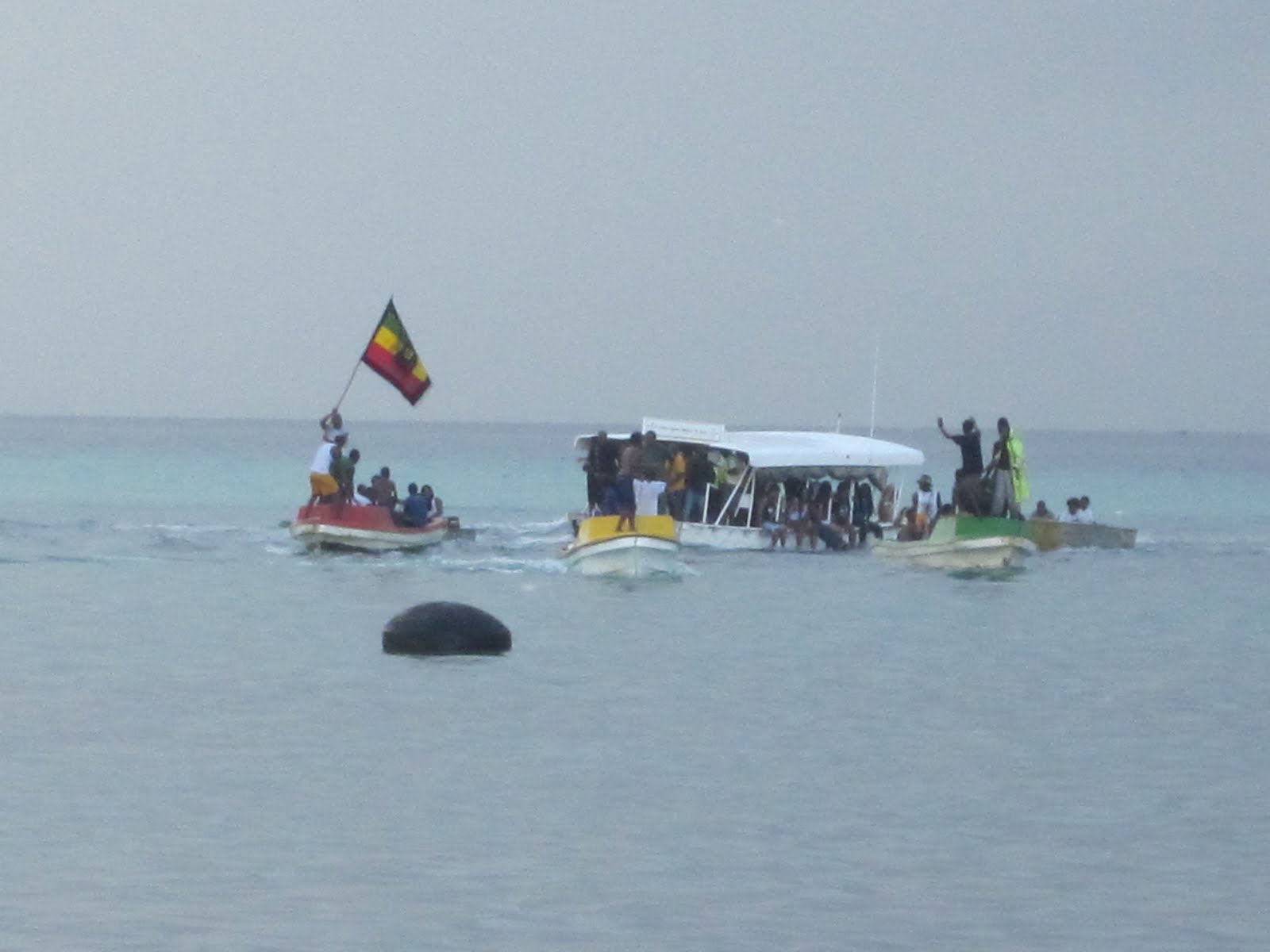
But then Kymani Marley stepped in and showed me the error of my impatience. Now in the U.S. when an offspring of Bob Marley announces a concert date, for most of us it means nothing more than an excuse to wear hemp, wave a lighter back and forth, and maybe even smoke something you haven't touched since college. But in Rasta-crazed Vanuatu any son of Bob Marley is royalty, and consequently this week leading up to his concert has produced waving flags, Reggae blasting from every speaker, and posters of Kymani plastered on every available surface. To say people are excited would be an understatement. As I was bumping along today in a beat up old bus on my way home to my hotel, my driver suddenly turned into a dirt parking lot close to the waterfront. "Be, yumi go wea?" I asked the driver, hoping I wouldn't have to brave the downpour to find another bus going my direction. The driver turned around and excitedly told me Kymani Marley's boat was about to land on this very dock. He then asked, with the pleading eyes of a child in an ice-cream shop, if we could please just wait 5 minutes till he arrived. He just wanted a look at the legendary man's son. Although I was annoyed and the word "typical" flew through my brain, I fought down my new-found cynicism and agreed that we could indeed hang out for a few minutes. I got out of the bus, camera in hand, and waited. Soon a group of boats could be seen coming around the corner, and the sight took my breath away. One weighed down boat with the celebrity on board was surrounded by smaller boats, overloaded to their limits, zipping around the bay. People were singing, using the side of the boats as drums, and waving a huge flag. Not part of his official posse, people had jumped on any seaworthy (I use that term lightly) craft they could find and rushed to be part of this Rasta sea parade. People began to swarm off the streets and line the dock, all wanting a look at Mr. Marley. It had the feeling of a carnival and everyone was laughing, singing, making beats, and dancing long after the superstar had entered his hotel.

I don't care that I saw Kymani Marley. Until a few days ago I didn't know he existed. So why was he the perfect form of couple's therapy for Vanuatu and me? I'm not exactly sure. It was just another display of chaos that is so prevalent in this country, but for some reason I began to smile and cannot stop. The people of this crazy country are so vibrant and alive. Yes, things can be extremely annoying here, but you will always find people willing to dance, laugh, and sing. And aren't mutual love, a sense of humor, and a dedication to working things out the most important things in a relationship? Maybe I'll give Vanuatu another chance. But I better be getting flowers out of this. . .

Wednesday, February 2, 2011

You can help!

As you sit at your computers, reading about the amazing people that live in Vanuatu and some of the extreme challenges they face every day, I bet you often wish you could do something to help improve the lives and the opportunities for these unique and wonderful people. Well good news - now you can! By following the link below you can donate any amount of money, however small, to help the Gender and Development committee work to provide support for the country's youth.

But what is the GAD committee? We are a group of eight volunteers who meet three times a year and try to address issues of gender inequality, gender-based violence, and others in Vanuatu. As our mission statement says, our goal is to "encourage cooperation between women and men to build strong families, communities, and nation." This encompasses a broad range of activities from raising awareness of domestic violence to helping people re-evaluate gender roles to providing training for Peace Corps volunteers in GAD related issues. But one of the most important things the GAD committee does is to focus on educating the youth of Vanuatu and helping foster confidence, leadership skills, healthy relationships and much more. As we focus on empowering the young people of this country we are ensuring that the next generation of Ni-Vanuatu will have the strength and the tools to improve the country from within. By providing training we can hope to put into place a sustainable development plan that will flourish without volunteers and will hopefully eventually make Peace Corps's presence in Vanuatu unnecessary.

A way to accomplish this is by running BILD (Boys In Leadership Development) and GLOW (Girls Leading Our World) camps in different locations around the country. These camps are a great way to gain access to and engage the country's youth and have been proven time and time again to be effective. Although the Peace Corps is extremely supportive of the GAD committee and our mission, unfortunately for the moment there is no available funding for us to run these camps. So instead, we look to you! You can help us accomplish our goals by donating any amount of money. Any gift of any size is greatly appreciated and gets us one step closer to our goal. So if you want to help the youth of Vanuatu, or get a nice little tax deduction, or if you just want to support your favorite Peace Corps blogger, please follow the link and donate anything you can. Thank you!!

https://www.peacecorps.gov/index.cfm?shell=donate.contribute.projDetail&projdesc=461-043

Monday, January 31, 2011

Girl Quatamwele

I am back in Vila for more training classes and I find my impression of the city has completely changed. When I first got to Vanuatu I thought Vila was a dirty, sleepy little town with not much going on. Although I still think it’s dirty, now I view the rushing trucks, rows of stores and restaurants, anchored yachts, and so many white people with the wide eyes of a country bumpkin. And I suppose really, that description wouldn’t be too off the mark.

I expected as a Peace Corps volunteer in a 3rd world country I wouldn’t be living in a Hilton with wireless internet and 24 hour room service. I also expected that whatever my living conditions ended up being they would no doubt evoke feelings of sympathy from those faithfully following my blog at home. However what I did not expect was the outpouring of horror and concern that would come from local people on my own island when I mention my home village.

Inevitably, when people hear I live in Quatamwele, they give one of three reactions: they emit a low whistle and shake their heads; they grasp my hand tightly and say, “Oh, sori!” like I just told them the family pet died; or they simply laugh and laugh. The times I make it into the small “town” of Lolowai, shopkeepers will see me and yell out, “Luk! Gel Quatamwele i kam daon lo bush!” causing everyone in the store to stare at me, or residents might simply shout, “Woman Bush!” as I walk by.

Even on North Ambae, where the stores are fewer, cold drinks are impossible to come by, and only one brave truck will dare take on the dirt roads, I am still a source of curiosity and concern. People in the villages on the coast, like Nancy’s Vandue or the neighboring Waluimbwe, are constantly asking how I’m doing “up there.” When I come down to visit, some worried mama will predictably take my hand, and with her brows knit together will lean close and ask in a low voice, “How are you?” No matter how convincingly I say, “Great! Things are great!” she will keep a hold of my hand, concerned eyes searching my face as she asks again, “No, but seriously. How are you??” Although the concern and mothering can be comforting being so far from home, I start to get a little annoyed by people’s constant anxiety that I’m wasting away in the jungle. My favorite fretful mama story comes from Waluimbwe when a particularly apprehensive woman said to me: “Oh my goodness, how are you feeling? Are you sick? Because you look awful!” Being in perfect health I was initially slightly peeved at this woman’s undisguised horror at my appearance, but to be fair I tried to assess the situation through her eyes. And what I saw was a little white girl standing in front of her, feet eternally dirty, mold growing on her skirt, shirt smelling like algae from the dirty creek it was last washed in, a mixture of sweat and dirt plastering her hair to her forehead, and wearing a broken flip flop. Ohhhhh, I did look awful! But up in the bush this is the normal way of things. We don’t concern ourselves with petty things like appearance and cleanliness. Up there the way I looked wouldn’t have garnered a second look. Maybe I have been in the bush too long!

But despite people’s dismay at my living conditions, I really like it up here. Sure I may eat only local kakae instead of rice and meat, and sure I may fall asleep to the sound of frogs and cicadas instead of the whiring of generators and the twanging of local “string band” music. But it’s peaceful in the bush and we live a happy, quiet life. I’m sure it must seem unlikely to all of you. Here I am—a girl with more pairs of stilettos than stamps on her passport, a girl whose drink at Starbucks takes longer to order than to consume, and a girl whose idea of hardship is when her favorite Indian restaurant is closed for remodeling and she has to get Thai for take-out instead—living in a bamboo house without electricity or running water. But the truth is I’m here, I’m making it, and I actually (mostly) enjoy it. I am Woman Bush, I am Girl Quatamwele, and I’m proud of it.

Friday, January 28, 2011

Patrick and William

Patrick and William are my sister Yvette’s two youngest children and are about 4 and 2 years old respectively. These munchkins spend their days running around the village, causing a ruckus and generally living out every boy’s dream. In this place, no one is a stranger and there is no danger of being kidnapped, so kids are free to roam at will. Patrick and William might disappear for hours on end but their mother remains unconcerned, assuring me they must be at their grandparents’ house or playing in the creek. Besides “don’t talk to strangers”, “don’t run with scissors” is another phrase never heard in the jungles of North Ambae. It is rare to see Patrick without a machete twice the length of his arm, and even William likes to wander about with a knife clutched in his chubby toddler’s hand.

William is a loving, smiling little guy and unbeknownst to him made my transition here a little easier. One of the first nights I was in Quatamwele we were having a goodbye for the former volunteer and amidst the speeches, the tears, and the eating; William kept coming over to me and climbing in my lap. His mother was appalled at his boldness and in embarrassment tried to scold him. But he was undeterred and nestled himself into my arms. William has started to talk but only speaks the local language. Sometimes we will have a conversation—me speaking Bislama and him speaking a mixture of language and toddler gibberish—and although neither of us knows what the conversation is about, William will cock his head as if listening closely to me and I will nod in understanding at his undoubtedly profound statements. He has earned many nicknames from his mother and me including “Man Bush” for his affinity for taking off his pants and “Hurricane” for his propensity to destroy plants in the garden with his ever present knife.

Patrick is a precocious thing and is going through the phase where he just wants to be a big kid like his siblings (I don’t have the heart to tell him that longing will last into his adult years until he finally reaches 21 and thanks God he’s not old and boring like his siblings J). Every morning his little voice sings out, “Gud moning Mac!” and sometimes he will simply poke his head around my door and say, “Hey!” Today as I sat in my house working, he came by and stated: “Hea blo yu i naes.” (basically he told me my hair looked good today). What a flirt. Patrick is clever and observant and always making me laugh with his unexpectedly on target remarks. When he recently went to Vila with his parents, his mom told me every white woman he saw he would grab her arm and say excitedly, “Look! It’s Momi Mac!” She would have to explain it was someone else and his face would fall in disappointment. Although he’s a good older brother, sometimes I will catch Patrick poking William with a stick or throwing seeds at him until William starts to cry and Patrick adopts an innocent look on his face.

These two keep me laughing with their antics and charm me with their loving ways. In our “family” they are supposed to call me Momi and they have taken on my new role with enthusiasm. They come to me with special rocks to show me, they cry to me when they skin their knees, and William is even comfortable enough to pee right on the floor of my house. I knew I wasn’t ready for kids yet!